The Palestinian Gazelle

The Palestinian Gazelle
2017 | 8' | Palestine
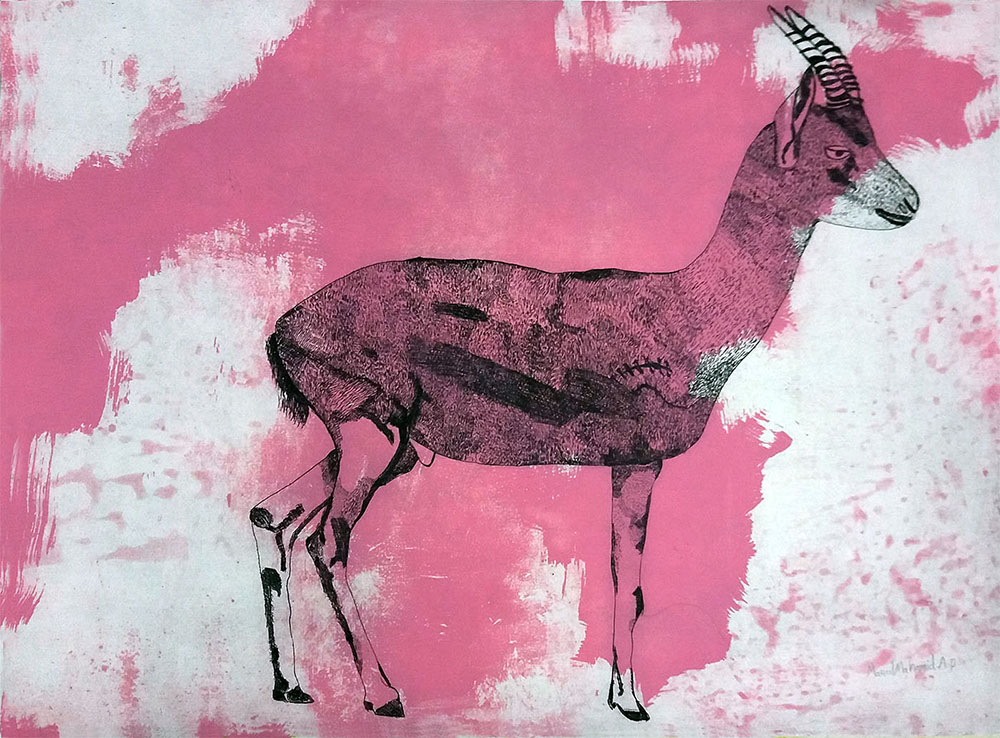
En créant The Palestinian Gazelle, j’ai cherché à souligner comment les forces coloniales non seulement contrôlent les récits humains, mais aussi manipulent les discours écologiques. À travers des vidéos, des sculptures et des médias mixtes, j’ai tracé les voyages de la gazelle à travers un paysage divisé et militarisé, défiant les points de contrôle, les frontières et les clôtures. À travers ces terrains, je voulais saisir l’absurdité des frontières imposées sur une terre qui coulait librement. L’acte de courir est devenu une métaphore visuelle de la résistance : un refus d’accepter la fragmentation et une revalorisation de la continuité naturelle de la terre, remettant à la fois en question la dégradation de l’environnement et la politique de l’apartheid écologique qui cherche à compartimenter et à contrôler le mouvement. Ma sculpture à grande échelle de la gazelle amputée est une représentation délibérée de cette résilience. Malgré son membre manquant, la gazelle est fière – non pas comme une créature pitoyable, mais comme un survivant – un reflet d’une identité perturbée mais ininterrompue. Il représente un paysage qui, comme la gazelle, a été coupé et revendiqué, tout en continuant à durer. En mettant l’accent sur le corps mutilé mais durable de la gazelle, je voulais aborder les questions plus larges du traumatisme environnemental – où la terre et ses habitants portent les cicatrices visibles et invisibles des conflits. L’utilisation de la gazelle dans mon travail est une façon de réaffirmer sa véritable identité – une identité profondément enchevêtrée avec l’histoire et l’écologie de la Palestine. Je suis fasciné par la façon dont l’image de l’animal apparaît dans la littérature, la poésie et la musique arabes en tant que symbole d’aspiration et de connexion à la terre. C’est une image qui appartient à une époque avant les frontières et le fil de fer barbelé, où la terre était entière. Dans mon travail, j’ai l’intention de rendre visible la tension entre ce qu’était la terre, ce qu’elle était forcée d’être, et ce qu’elle pourrait être si elle était libérée de ces contraintes. En plaçant la gazelle dans des paysages qui s’étendent du nord au sud de la Palestine historique, j’invite les spectateurs à réinventer la terre telle qu’elle était autrefois continue, entière et résiliente. Je veux que les gens voient non seulement la beauté physique de la gazelle, mais aussi l’histoire écologique et politique qu’elle raconte. Il ne s’agit pas seulement d’un animal, c’est une archive vivante d’une terre assiégée, d’une créature prise entre survie et perte, et un rappel que, même face aux tentatives d’amputer son histoire, elle perdure. The Palestinian Gazelle,J’espère aborder non seulement l’effacement politique d’un peuple, mais aussi les impacts environnementaux et écologiques de ces récits. Le projet est ma façon de récupérer le paysage et d’affirmer une forme de justice écologique qui insiste sur l’indisséparabilité de la terre, de l’identité et du monde naturel. Pour moi, le voyage de la gazelle est une histoire de continuité interrompue mais ininterrompue – un emblème de l’endurance écologique et culturelle qui refuse de se limiter aux définitions étroites imposées par les récits coloniaux.
In creating The Palestinian Gazelle, I aimed to highlight how colonial forces not only control human narratives but also manipulate ecological ones. Through video, sculpture, and mixed media, I traced the journeys of the gazelle across a divided and militarized landscape, defying checkpoints, borders, and fences. Running through these terrains, I wanted to capture the absurdity of imposed boundaries on a land that once flowed freely. The act of running became a visual metaphor for resistance: a refusal to accept fragmentation and a reclamation of the land’s natural continuity, challenging both environmental degradation and the politics of ecological apartheid that seek to compartmentalize and control movement. My large-scale sculpture of the amputated gazelle is a deliberate representation of this resilience. Despite its missing limb, the gazelle stands proud — not as a pitiful creature, but as a survivor—a reflection of a disrupted yet unbroken identity. It represents a landscape that, like the gazelle, has been cut apart and claimed, yet continues to endure. By emphasizing the mutilated yet enduring body of the gazelle, I wanted to address the broader issues of environmental trauma — where the land and its inhabitants bear the visible and invisible scars of conflict. The use of the gazelle in my work is a way of reasserting its true identity — one that is deeply entwined with the history and ecology of Palestine. I am fascinated by how the animal’s image appears throughout Arab literature, poetry, and music as a symbol of longing and connection to the land. It is an image that belongs to a time before borders and barbed wire, when the land was whole. In my work, I aim to make visible the tension between what the land was, what it is forced to be, and what it could be if freed from these constraints. By placing the gazelle in landscapes that span from the north to the south of historic Palestine, I invite viewers to reimagine the land as it once was — continuous, whole, and resilient. I want people to see not just the physical beauty of the gazelle but the broader ecological and political story it tells. This is not just an animal; it is a living archive of a land under siege, a creature caught between survival and loss, and a reminder that even in the face of attempts to amputate its history, it endures. Through The Palestinian Gazelle, I hope to address not only the political erasure of a people but also the environmental and ecological impacts of these narratives. The project is my way of reclaiming the landscape and asserting a form of ecological justice that insists on the inseparability of land, identity, and the natural world. For me, the gazelle’s journey is a story of interrupted yet unbroken continuity — an emblem of ecological and cultural endurance that refuses to be confined to the narrow definitions imposed by colonial narratives.
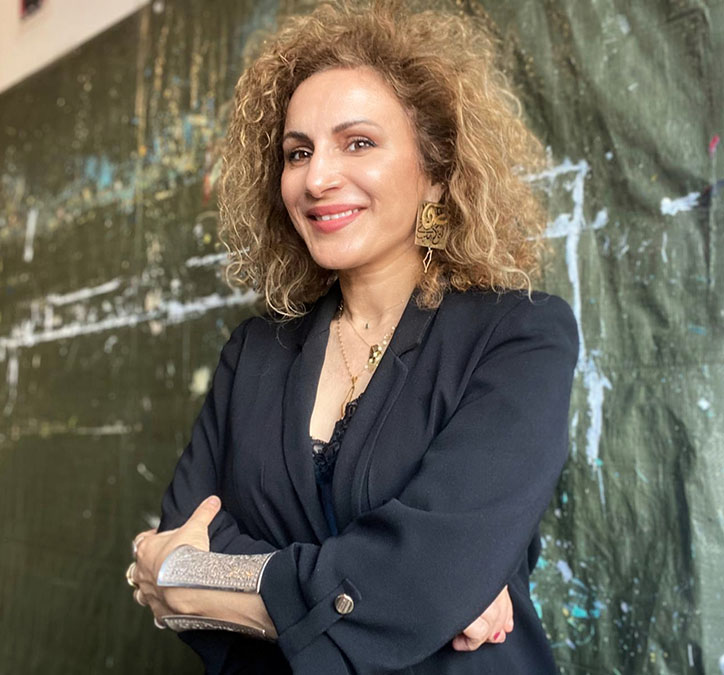
Manal Mahamid (1976) est un artiste palestinien multidisciplinaire basé à Haifa et à Dublin depuis 2020. Né à Moawia, un village palestinien, Mahamid a développé un ensemble varié de travaux qui couvrent la sculpture, la vidéo, l’installation, la peinture et la photographie. Elle a obtenu sa maîtrise en beaux-arts à l’Université de Haifa en 2006, grâce à une bourse d’excellence de l’université. En 2010, elle a obtenu un diplôme en muséologie et cururation de l’Université de Tel-Aviv. En 2024, elle a terminé une maîtrise en politique culturelle et de gestion des arts de l’University College de Dublin (UCD). Le travail de Mahamid a été reconnu avec de nombreuses éloges, y compris en étant présélectionné pour l’A.M. Prix du jeune artiste de l’année Qattan en 2002. Elle a reçu le prix de l’artiste résidente de la Fondation Delfina en 2007 dans le cadre de la Biennale de Riwaq, une collaboration entre la Fondation Delfina et l’A.M. Fondation Qattan. Son art a été présenté dans plus de 50 expositions collectives dans le monde entier, avec des expositions remarquables à Londres, Chicago, Le Caire, Dusseldorf, Haifa, Ramallah, Um El Fahim et Jericho. Elle a également participé au Festival international de Qalandiya en 2014 et 2016, organisé par l’Association arabe de la culture à Haifa. Ses expositions solo comprennent The Tale of a Gazelle (2016), Work in Progress, et sa dernière exposition Lines of Flight in Waterford
Manal Mahamid (1976) is a conceptual multidisciplinary Palestinian artist based in Haifa and Dublin since 2020. Born in Moawia, a Palestinian village, Mahamid has developed a diverse body of work that spans sculpture, video, installation, painting, and photography. She earned her Master’s in Fine Arts at the University of Haifa in 2006, thanks to a scholarship of Excellence from the university. In 2010, she obtained a degree in Museology and Curation from the University of Tel Aviv. In 2024, she completed a Master’s in Culture Policy and Arts Management from University College Dublin (UCD). Mahamid’s work has been recognized with numerous accolades, including being shortlisted for the A.M. Qattan Young Artist of the Year Award in 2002. She received the Delfina Foundation’s Resident Artist Award in 2007 as part of the Riwaq Biennale, a collaboration between the Delfina Foundation and the A.M. Qattan Foundation. Her art has been showcased in over 50 group exhibitions worldwide, with notable exhibitions in London, Chicago, Cairo, Dusseldorf, Haifa, Ramallah, Um El Fahim, and Jericho. She also participated in the Qalandiya International Festival in 2014 and 2016, organized by the Arab Culture Association in Haifa. Her solo exhibitions include The Tale of a Gazelle(2016), Work in Progress, and her most recent exhibition Lines of Flight in Waterford